
Let cameras handle the repetitive checks.
Vision AI and smart cameras help you catch defects faster, reduce manual inspection time, and build better evidence for quality decisions—especially on busy assembly and packing lines.
A simple view of how Vision AI can replace or augment manual checks on an assembly line. Layout and data are illustrative.
- Presence/absence of critical components.
- Orientation and alignment within tolerances.
- OCR for part codes and date/lot markings.
Pass/fail signals to PLC, images stored for evidence, and statistics fed into your quality dashboards.
What Vision AI & inspection systems add
Bring automation to repetitive checks, while keeping humans focused on exceptions and improvement.
Inspection flow: Camera → AI Model → Detection → Decision
A quick view of how an inspection gate works on a line—clean, repeatable, and traceable.
Manual inspection vs Vision AI on an assembly line
Vision AI doesn’t replace your quality team—it gives them better tools and more consistent data.
- Inspectors check samples under time pressure.
- Results depend heavily on individual experience and fatigue.
- Evidence is limited to tick‑sheets and occasional photos.
- Every passing unit at the station is checked in the same way.
- Exceptions and borderline cases are flagged for human review.
- Images and statistics are stored for traceability and analysis.
- Inspectors spend more time on improvements and less on repetitive checks.
- Disagreements about “what was seen” are replaced by shared evidence.
- It’s easier to train new team members on clear, visual standards.
Defect detection visualization (what operators see)
Bounding boxes and highlights make it obvious where the problem is—so rework is faster and disputes drop.
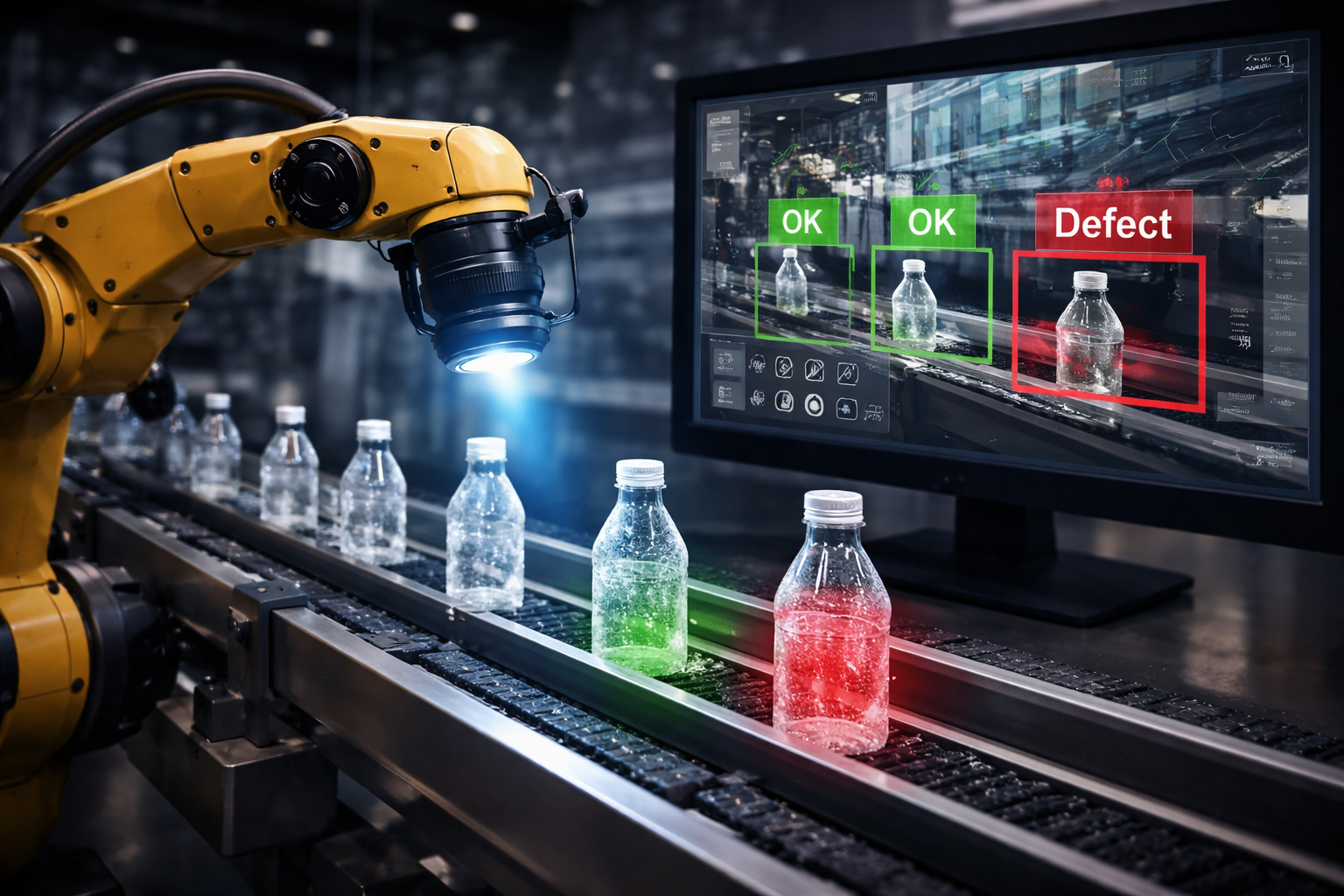
- Image + overlays (boxes/regions) for evidence.
- Defect type, confidence score, timestamp, station, operator/shift.
- Pass/fail decision and downstream action (rework / scrap / hold).
OCR example: reading engraved / printed text
Vision AI reads batch, date, and part codes even when lighting and surfaces vary—then validates the format automatically.
- Engraved serials on metal parts.
- Inkjet date/lot codes on packaging.
- Printed labels that must match order and product rules.
What plants typically see with Vision AI
Numbers vary, but these are the outcomes that operations and quality leaders expect from vision projects.
Automating repetitive checks reduces bottlenecks at inspection stations.
The same criteria are applied on every unit, shift after shift.
Subtle defects that are easy to miss visually can be picked up more reliably.
Why manual inspection fails at scale
Manual inspection has its place—but at high volumes and complexity, it struggles to keep up.
- Humans get tired; attention and judgment naturally vary across a shift.
- As product variants increase, so does the chance of mixing up criteria.
- It’s hard to prove what was checked when there’s little objective evidence.
- Applies the same rules consistently, unit after unit.
- Flags only exceptions for humans to review and decide.
- Builds a library of examples that training and engineering can learn from.